InIt CTF: The Fractured Key
Description
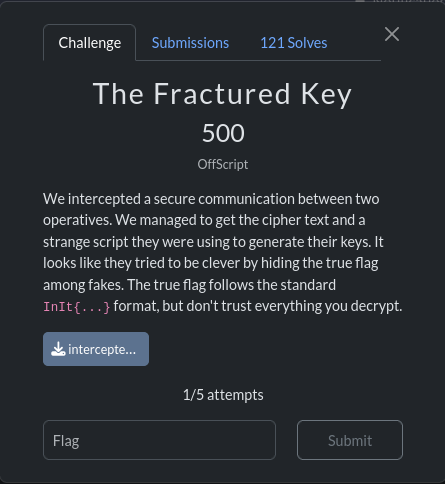
We intercepted a secure communication between two operatives. We managed to get the cipher text and a strange script they were using to generate their keys. It looks like they tried to be clever by hiding the true flag among fakes. The true flag follows the standard InIt{...} format, but don’t trust everything you decrypt.
500 points, category OffScript. Handout: intercepted.zip
Question & Flag
What’s in the handout?
1
2
3
4
$ unzip intercepted.zip
Archive:  intercepted.zip
  inflating: intercepted.txt
  inflating: key_gen.py
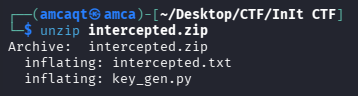
intercepted.txt is three hex-encoded AES ciphertexts, one per line. key_gen.py is the “strange script” they used to generate their keys:
1
2
3
4
5
6
7
8
9
10
11
12
13
14
15
16
17
18
19
20
21
import os
import random
from Crypto.Cipher import AES
from Crypto.Util.Padding import pad

# We need a 32-byte key for AES-256
def generate_master_key():
    # To make it extra secure, we base it on a random seed
    seed = random.randint(0, 255)
    random.seed(seed)

    key = bytearray()
    for _ in range(32):
        key.append(random.randint(0, 255))
    return bytes(key)

def encrypt(data: bytes) -> bytes:
    key = generate_master_key()
    iv = os.urandom(16)
    cipher = AES.new(key, AES.MODE_CBC, iv=iv)
    return iv + cipher.encrypt(pad(data, AES.block_size))
Spotting the bug
It looks like a proper AES-256 key, 32 random bytes. But look at where the randomness actually comes from:
1
2
seed = random.randint(0, 255)
random.seed(seed)
The “master key” is entirely decided by one byte, 0 to 255, fed into Python’s random.seed(). Python’s random module is a Mersenne Twister, not a cryptographically secure generator, so the same seed always produces the exact same 32 bytes afterward. That means the real key space isn’t 2²⁵⁶, it’s just 256. Instead of brute-forcing AES-256, which is never happening, we only need to brute-force which one of 256 seeds was used.
The IV is also shipped in the clear, prepended to the ciphertext by encrypt(), so once we land on the right seed, decryption is just normal AES-CBC.
Brute-forcing the seed
Took key_gen.py’s own function and made the seed an argument instead of random, then just looped all 256 of them. A wrong key fails PKCS7 unpadding almost every time, so “unpadding succeeded and the result is printable ASCII” is enough to tell us we hit the right seed.
1
2
3
4
5
6
7
8
9
10
11
12
13
14
15
16
17
18
19
20
21
22
23
24
25
26
27
28
import random
from Crypto.Cipher import AES
from Crypto.Util.Padding import unpad

def generate_master_key(seed):
    random.seed(seed)
    key = bytearray()
    for _ in range(32):
        key.append(random.randint(0, 255))
    return bytes(key)

def crack(line):
    data = bytes.fromhex(line.strip())
    iv, ct = data[:16], data[16:]
    for seed in range(256):
        key = generate_master_key(seed)
        cipher = AES.new(key, AES.MODE_CBC, iv=iv)
        try:
            pt = unpad(cipher.decrypt(ct), AES.block_size)
        except ValueError:
            continue
        if all(32 <= b < 127 for b in pt):
            print(f"seed {seed}: {pt.decode()}")

with open("intercepted.txt") as f:
    for line in f:
        if line.strip():
            crack(line)
1
2
3
4
$ python3 solve.py
seed 42: InIt{w0w_y0u_f0und_1t_but_1ts_f4k3}
seed 201: InIt{ps3ud0_r4nd0m_1s_n0t_r4nd0m_k3y_sp4c3_t00_sm4ll}
seed 137: InIt{h4h4_n1c3_try_k33p_l00k1ng}

Don’t trust everything you decrypt
All three lines decrypt cleanly, which is exactly the warning in the description. Two of them are decoys there to bait a rushed submission:
InIt{w0w_y0u_f0und_1t_but_1ts_f4k3}— taunts you for finding itInIt{h4h4_n1c3_try_k33p_l00k1ng}— taunts you for trying
The third is the only one that actually describes the bug we just exploited, predictable PRNG seed collapsing the key space, so that’s the real flag.
1
InIt{ps3ud0_r4nd0m_1s_n0t_r4nd0m_k3y_sp4c3_t00_sm4ll}
Conclusion
Textbook lesson in why random.seed() and the standard random module have no business anywhere near key generation, use secrets or os.urandom directly instead. Fun one too, since the decoys actually punish you for not reading your own exploit’s output carefully.
Happy Hacking
